Log in / Register
Luka Duffel
Original price: $138


Search


If you have ever searched for a duffel bag and wondered whether it should be spelled “duffel” or “duffle,” you are not alone. Both spellings are widely used, often interchangeably, and refer to the same classic bag style. While one spelling is technically more accurate, the other has become just as familiar in everyday use. Here is what you need to know about the difference, where the word came from, and why both versions still exist today.
Let’s clear it up right away. “Duffel” is the original and technically correct spelling, while “duffle” is a widely accepted variant that developed over time. Both spellings refer to the same type of soft-sided, cylindrical bag.
You will see both used by brands, retailers, and shoppers, and search engines understand them equally well. While “duffel” tends to appear more often in formal writing and dictionaries, “duffle” has become common in modern usage.
The name “duffel” comes from the town of Duffel, Belgium, where a thick, durable woolen fabric was produced as early as the 17th century. This fabric became well known for its strength and resistance to wear, making it ideal for outerwear and utility items.
Over time, the same heavy-duty material was used to create sturdy bags designed to carry personal belongings. Those bags eventually took on the name of the town where the fabric originated.
If you have ever searched for a duffel bag and wondered whether it should be spelled “duffel” or “duffle,” you are not alone. Both spellings are widely used, often interchangeably, and refer to the same classic bag style. While one spelling is technically more accurate, the other has become just as familiar in everyday use. Here is what you need to know about the difference, where the word came from, and why both versions still exist today.
Let’s clear it up right away. “Duffel” is the original and technically correct spelling, while “duffle” is a widely accepted variant that developed over time. Both spellings refer to the same type of soft-sided, cylindrical bag.
You will see both used by brands, retailers, and shoppers, and search engines understand them equally well. While “duffel” tends to appear more often in formal writing and dictionaries, “duffle” has become common in modern usage.
The name “duffel” comes from the town of Duffel, Belgium, where a thick, durable woolen fabric was produced as early as the 17th century. This fabric became well known for its strength and resistance to wear, making it ideal for outerwear and utility items.
Over time, the same heavy-duty material was used to create sturdy bags designed to carry personal belongings. Those bags eventually took on the name of the town where the fabric originated.


Before it was a bag, duffel referred to the fabric itself. The coarse woolen cloth produced in Duffel was originally used for items like coats, ship coverings, and workwear. Its durability made it especially useful in demanding environments.
As the fabric evolved and materials changed, the design of the bag remained focused on function. The early duffel bag was valued for its simple shape, large opening, and ability to carry bulky items with ease.
Before it was a bag, duffel referred to the fabric itself. The coarse woolen cloth produced in Duffel was originally used for items like coats, ship coverings, and workwear. Its durability made it especially useful in demanding environments.
As the fabric evolved and materials changed, the design of the bag remained focused on function. The early duffel bag was valued for its simple shape, large opening, and ability to carry bulky items with ease.
Before it was a bag, duffel referred to the fabric itself. The coarse woolen cloth produced in Duffel was originally used for items like coats, ship coverings, and workwear. Its durability made it especially useful in demanding environments.
As the fabric evolved and materials changed, the design of the bag remained focused on function. The early duffel bag was valued for its simple shape, large opening, and ability to carry bulky items with ease.
Before it was a bag, duffel referred to the fabric itself. The coarse woolen cloth produced in Duffel was originally used for items like coats, ship coverings, and workwear. Its durability made it especially useful in demanding environments.
As the fabric evolved and materials changed, the design of the bag remained focused on function. The early duffel bag was valued for its simple shape, large opening, and ability to carry bulky items with ease.
Yes, while “duffel” is historically correct, “duffle” is a commonly accepted spelling variation. Both terms refer to the same bag style, and both are recognized by dictionaries and retailers.
You can search, shop, and use either spelling without changing the meaning.
Today’s duffel bag has evolved far beyond its military roots. While many still picture the classic cylindrical design, contemporary duffels now come in a wide range of styles built for real-world travel and everyday use.
Today’s duffel bag has evolved far beyond its military roots. While the classic cylindrical shape still exists, modern duffels now come in a wide range of sizes and styles designed for different travel needs.
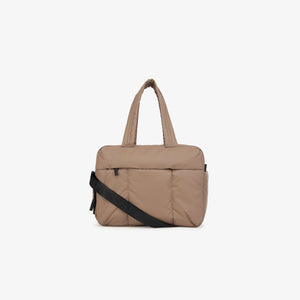
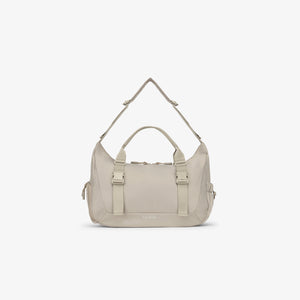
Contemporary duffel bags are often made with lightweight performance fabrics and include features like reinforced handles, detachable shoulder straps, shoe compartments, and trolley sleeves. You can find compact duffels sized for the gym or daily carry, mid-size options ideal for weekend trips, and larger duffels built to hold everything for longer travel.
For a closer look at the different ways duffel bags are styled and used, check out our types of duffels guide.
Whether you spell it duffel or duffle, this versatile bag has stood the test of time for good reason. With its flexible structure, generous capacity, and easy-to-carry design, it remains a go-to for everything from short trips to everyday carry. Explore our full collection of duffel bags to find the style that fits your travel routine.
Yes, while “duffel” is historically correct, “duffle” is a commonly accepted spelling variation. Both terms refer to the same bag style, and both are recognized by dictionaries and retailers.
You can search, shop, and use either spelling without changing the meaning.
Today’s duffel bag has evolved far beyond its military roots. While many still picture the classic cylindrical design, contemporary duffels now come in a wide range of styles built for real-world travel and everyday use.
Today’s duffel bag has evolved far beyond its military roots. While the classic cylindrical shape still exists, modern duffels now come in a wide range of sizes and styles designed for different travel needs.
Contemporary duffel bags are often made with lightweight performance fabrics and include features like reinforced handles, detachable shoulder straps, shoe compartments, and trolley sleeves. You can find compact duffels sized for the gym or daily carry, mid-size options ideal for weekend trips, and larger duffels built to hold everything for longer travel.
For a closer look at the different ways duffel bags are styled and used, check out our types of duffels guide.
Whether you spell it duffel or duffle, this versatile bag has stood the test of time for good reason. With its flexible structure, generous capacity, and easy-to-carry design, it remains a go-to for everything from short trips to everyday carry. Explore our full collection of duffel bags to find the style that fits your travel routine.